
HemorrhageFrankelEtAlPhysiologic20
Description
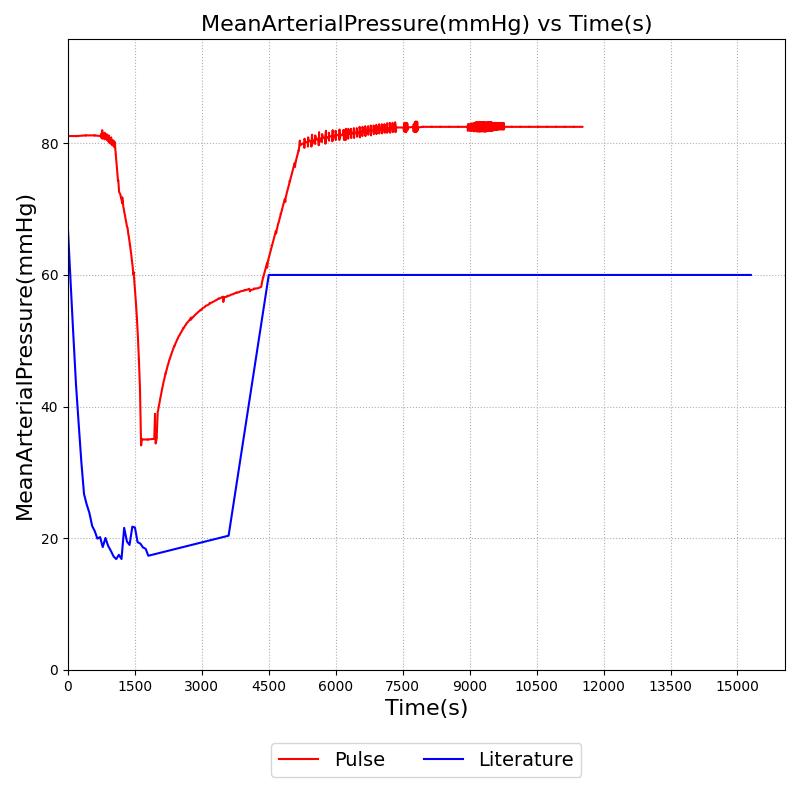
In Frankel, et al. 30 mL/kg (43% blood loss) of venous blood was removed from the pig to produce shock (defined by MAP of 20 mmHg). Shock was defined as maintaining MAP at less than 20mmHg for an hour. Resustitation was then started using Ringer's Lactate and whole blood with a ratio of 2:1 (28ml/kg Ringer's, then 14 ml/kg whole blood) to reach and mantain a MAP of 60mmHg for 120 minutes. The goal of this scenario was a physiologic hemorrhage rate over 20 minutes (2.15 mL/kg/min for 7 min and 1.15 ml/kg/min for 13 min).
To replicate this, 43% blood loss in the standard female is approximately 1800 mL or 30.5 mL/kg. This is close enough to 30ml/kg.
HemorrhageFrankelEtAlPhysiologic20
Description
In Frankel, et al. 30 mL/kg (43% blood loss) of venous blood was removed from the pig to produce shock (defined by MAP of 20 mmHg). Shock was defined as maintaining MAP at less than 20mmHg for an hour. Resuscitation was then started using Ringer's Lactate and whole blood with a ratio of 2:1 (28ml/kg Ringer's, then 14 ml/kg whole blood) to reach and maintain a MAP of 60mmHg for 120 minutes. The goal of this scenario was a physiologic hemorrhage rate over 20 minutes (2.15 mL/kg/min for 7 min and 1.15 ml/kg/min for 13 min).
To replicate this, 43% blood loss in the standard female is approximately 1800 mL or 30.5 mL/kg. This is close enough to 30ml/kg.
This is a link to Frankel, et al.
Segment Validation
Segment 1
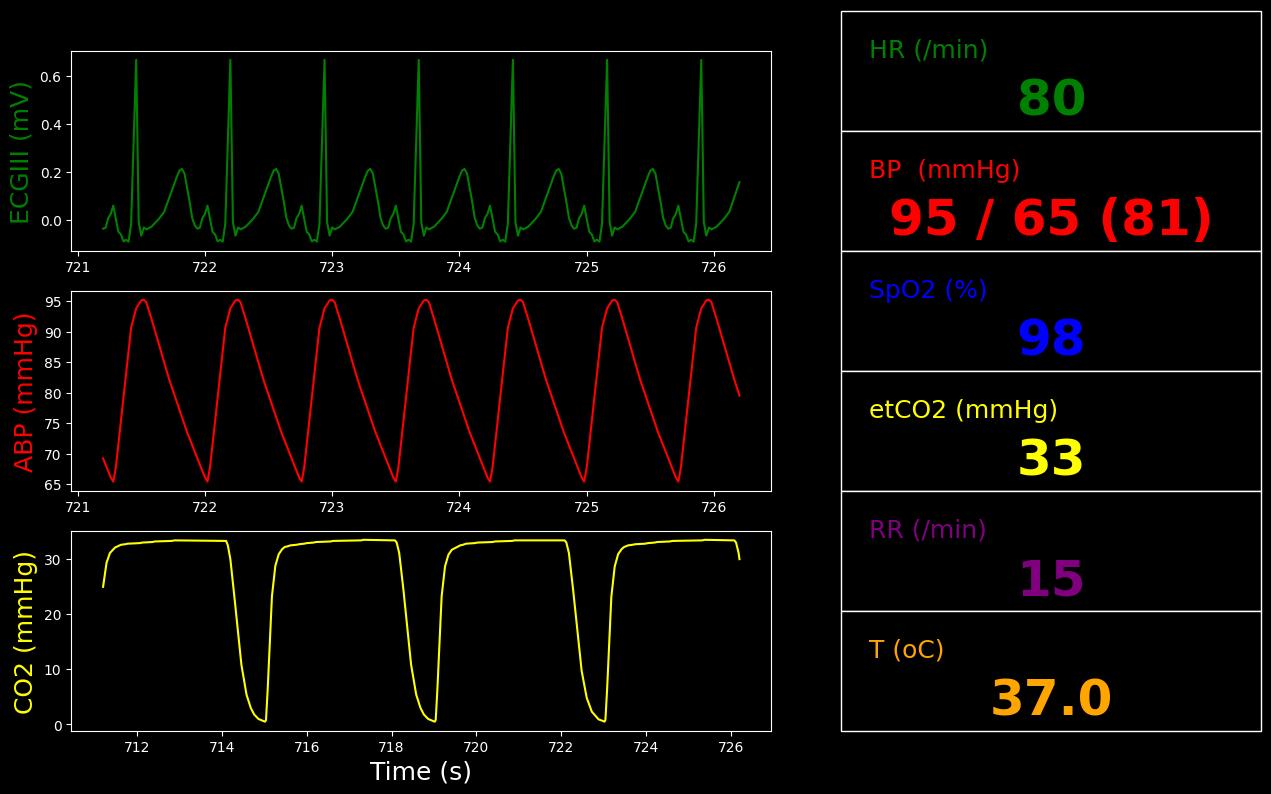
Lungs were mechanically ventilated in volume-controlled mode with a FiO2 of 0.21 and a PEEP of 5 cm H2O. Tidal volumes were adjusted to 7 to 10 mL/kg at 15 breaths per minute (fixed rate) to achieve a PaCO2 between 35 mmHg and 40 mmHg.
| Mode | VT (L) | Flow (L/min) | TI (s) | RR (bpm) | PEEP (cmH2O) | FiO2 |
|---|---|---|---|---|---|---|
| VC-CMV | 0.475 | 29 | 1.0 | 15 | 5 | 0.21 |
Run to homeostasis.
| Property Name | Validation | Engine Value | Percent Error | Percent Change | Notes |
|---|---|---|---|---|---|
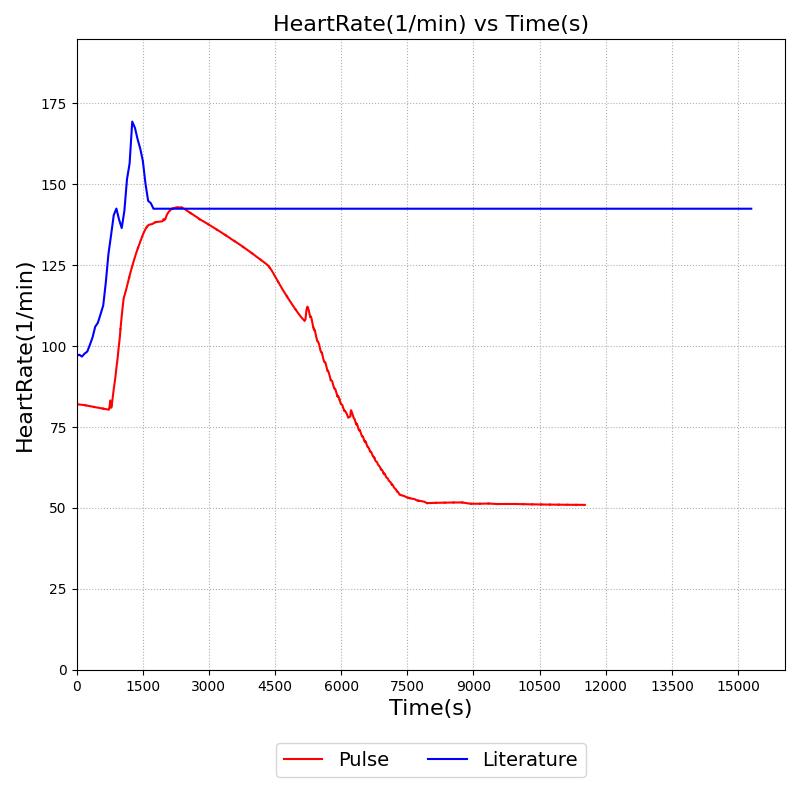
| HeartRate(1/min) | EqualTo 98 [128] | 80.4 | -18.01% | ||
| MeanArterialPressure(mmHg) | EqualTo 73 [128] | 81.2 | 11.24% | ||
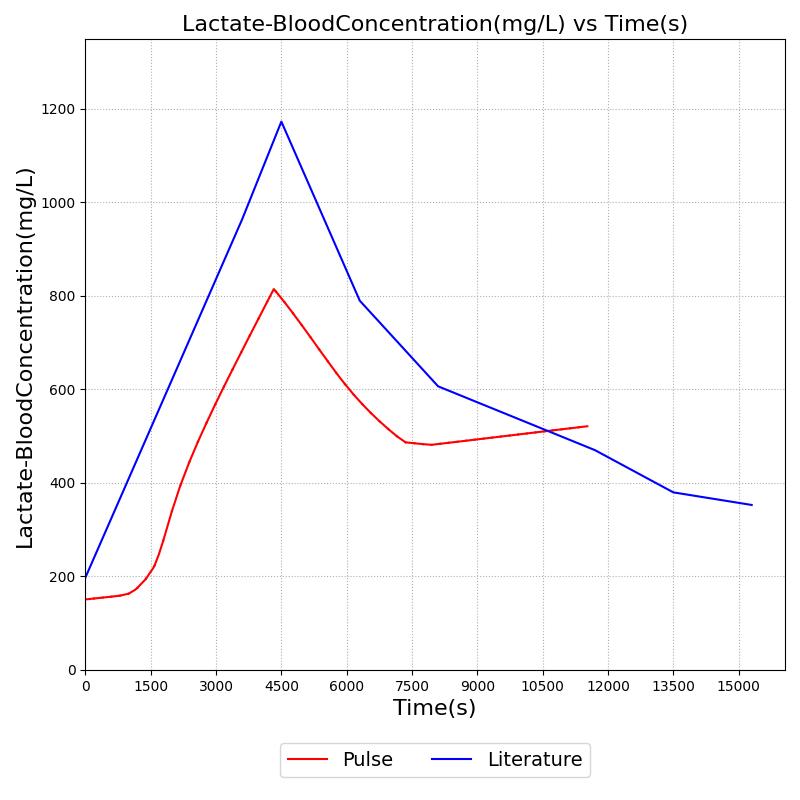
| Lactate-BloodConcentration(mg/dL) | EqualTo 20 [128] | 15.8 | -21.01% | ||
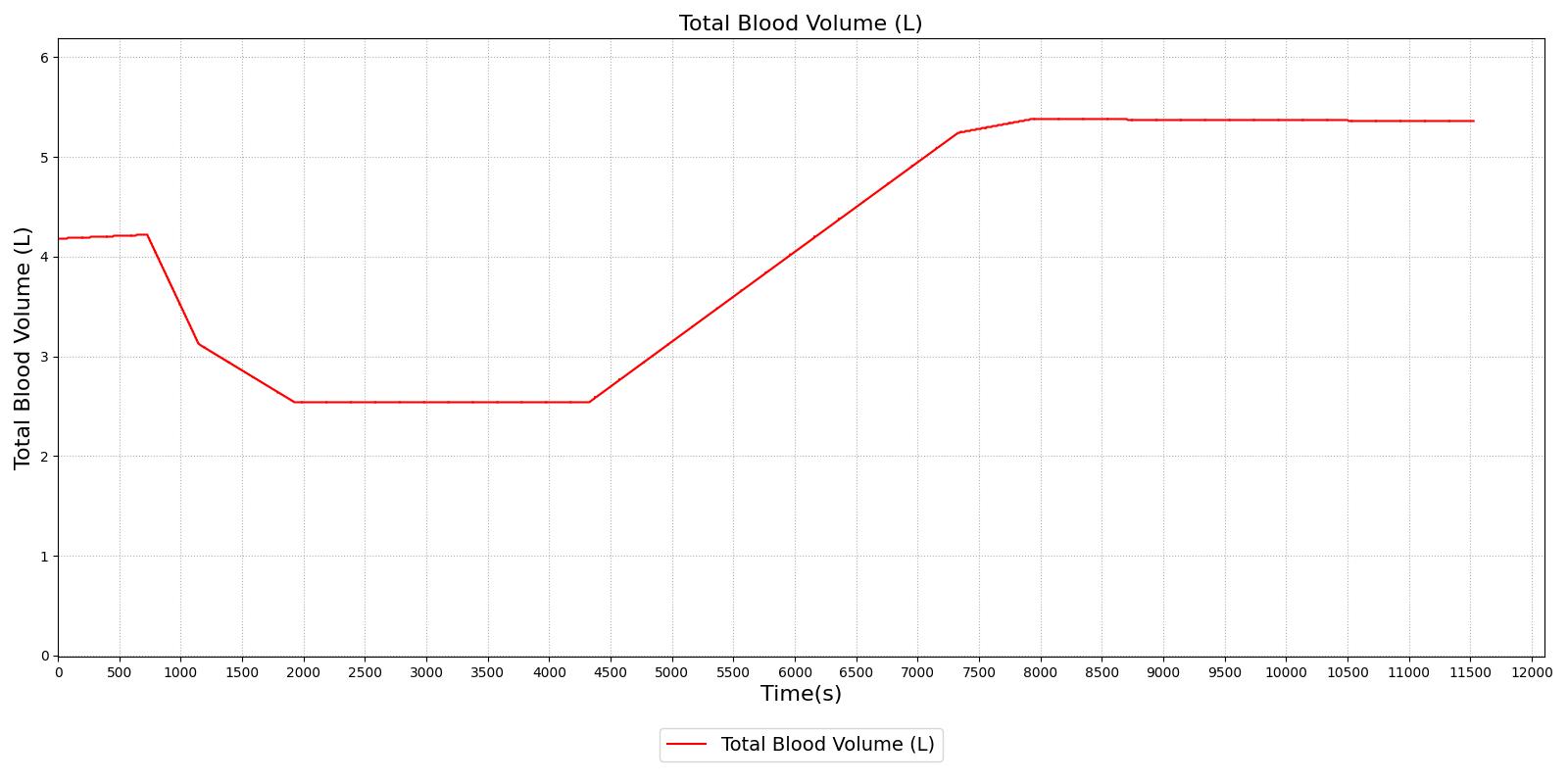
| BloodVolume(mL) | EqualTo 2920 [128] | 4.22e+03 | 44.52% | ||
| TotalHemorrhagedVolume(mL) | EqualTo 1180 [128] | 0.00 | -100.00% |
 |
Segment 2
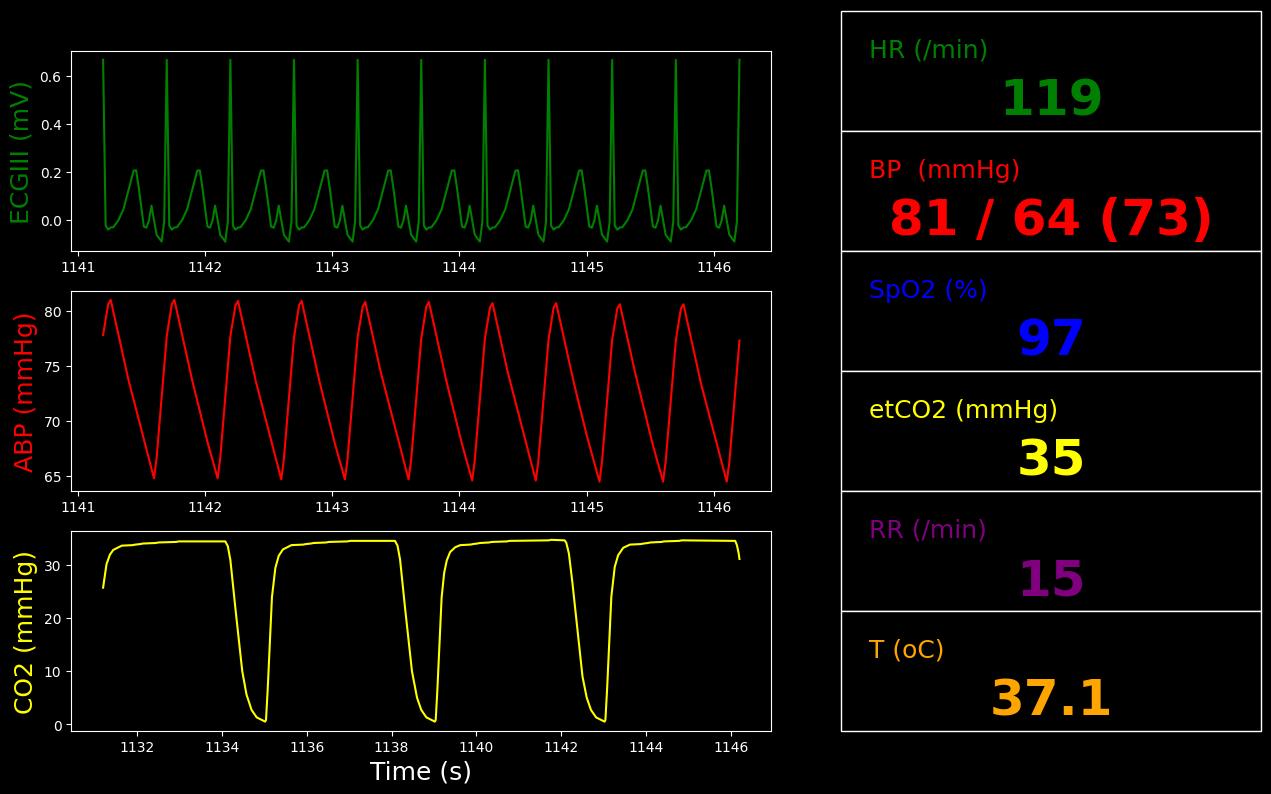
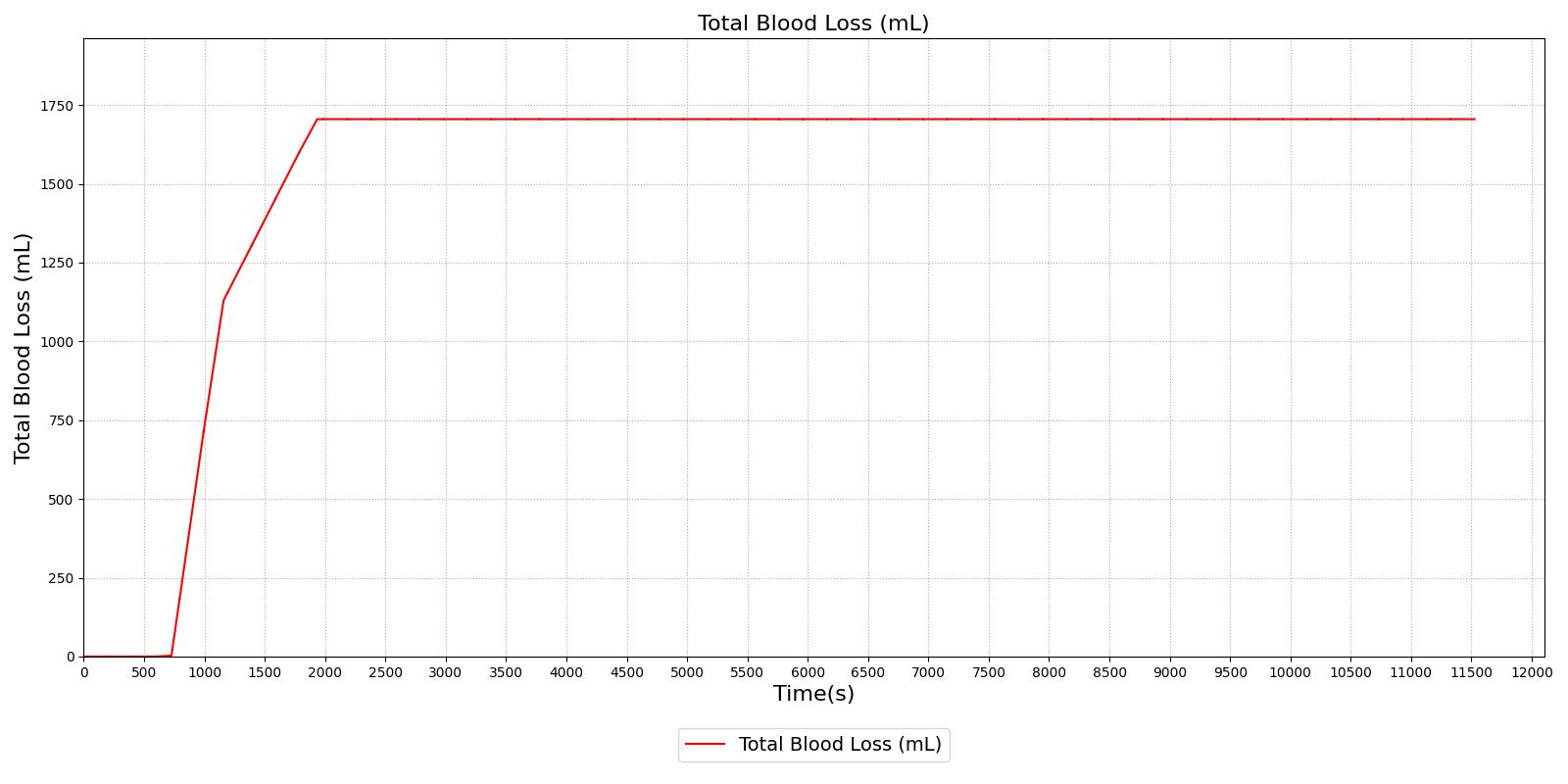
Initiate a controlled hemorrhage corresponding to 30 mL/kg for a 59 kg female. 59kg*30 ml/kg = 1180 ml -> / 7 min = 169 ml/min. This was pulled from the vena cava. Simulate for 7 minutes.
| Property Name | Validation | Engine Value | Percent Error | Percent Change | Notes |
|---|---|---|---|---|---|
| HeartRate(1/min) | EqualTo 1.17*Segment1 (94.0) [128] | 119 | 26.26% | ||
| MeanArterialPressure(mmHg) | EqualTo 0.41*Segment1 (33.3) [128] | 72.7 | 118.37% | ||
| Lactate-BloodConcentration(mg/dL) | EqualTo 3.25*Segment1 (51.3) [128] | 17.2 | -66.53% | ||
| BloodVolume(mL) | EqualTo 2920 [128] | 3.12e+03 | 6.85% | ||
| TotalHemorrhagedVolume(mL) | EqualTo 1180 [128] | 1.12e+03 | -5.09% |
 |
Segment 3
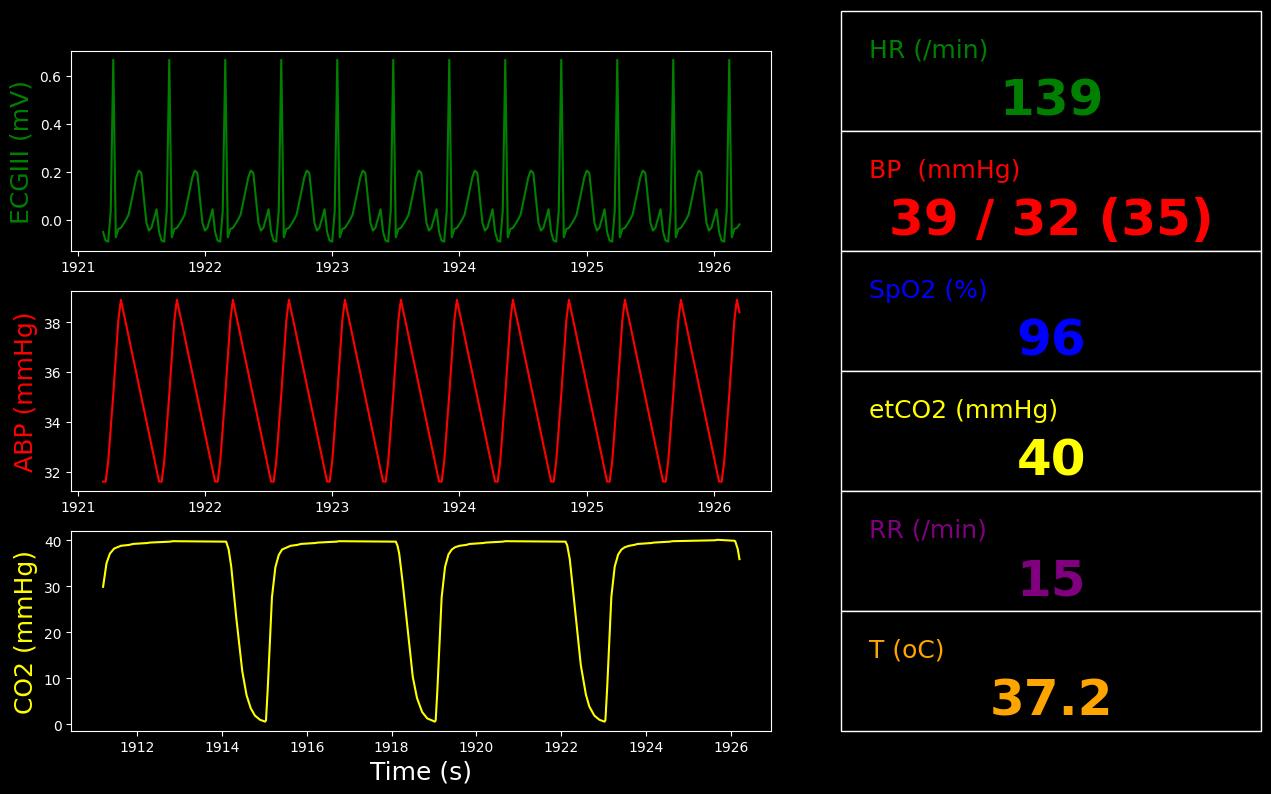
Reduce the controlled hemorrhage corresponding to 30 mL/kg for a 59 kg female. 59kg*30 ml/kg*2/3 = 1180 ml -> / 13 min = 45 ml/min. This was pulled from the vena cava. Simulate for 13 minutes.
| Property Name | Validation | Engine Value | Percent Error | Percent Change | Notes |
|---|---|---|---|---|---|
| HeartRate(1/min) | EqualTo 1.3*Segment2 (154) [128] | 139 | -10.24% | ||
| MeanArterialPressure(mmHg) | EqualTo 0.67*Segment2 (48.7) [128] | 35.0 | -28.19% | ||
| Lactate-BloodConcentration(mg/dL) | EqualTo 1.46*Segment2 (25.1) [128] | 32.0 | 27.65% | ||
| BloodVolume(mL) | EqualTo 2412 [128] | 2.54e+03 | 5.19% | ||
| TotalHemorrhagedVolume(mL) | EqualTo 1770 [128] | 1.70e+03 | -3.67% |
 |
Segment 4
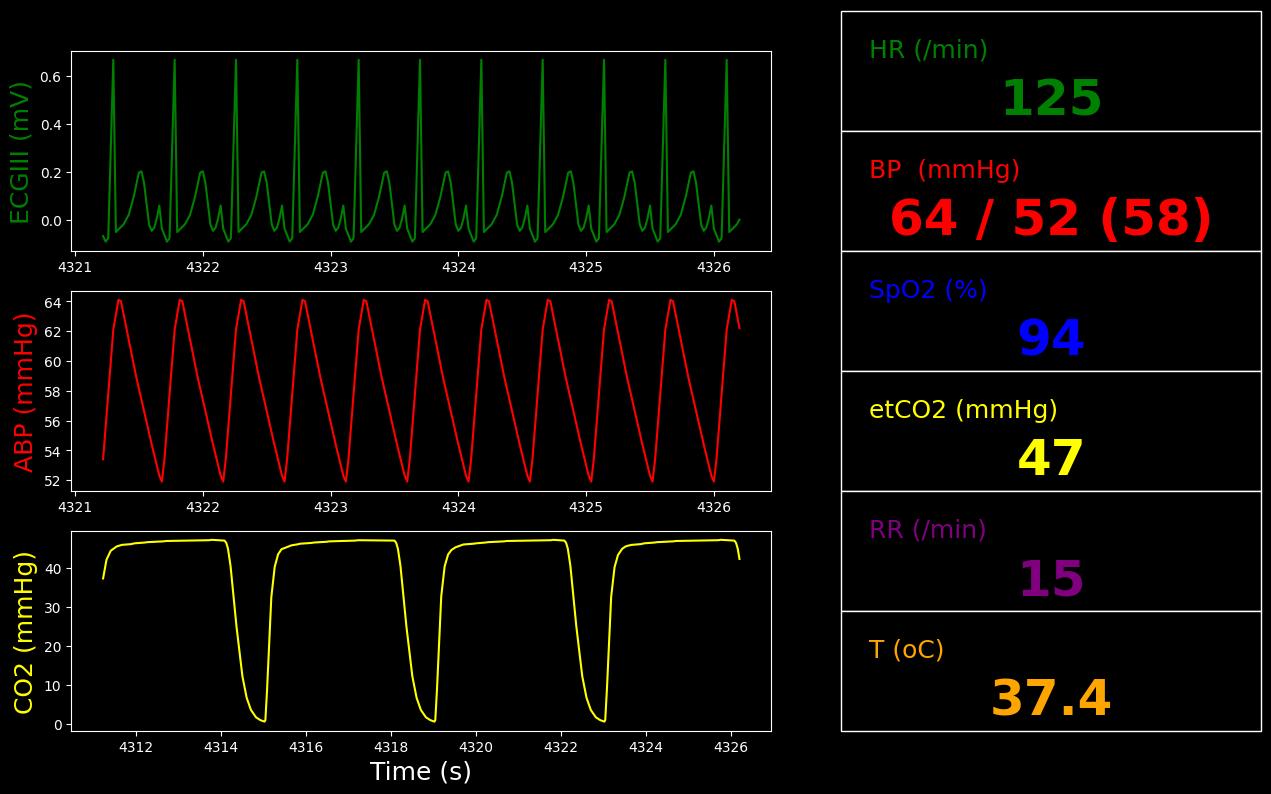
Stop the controlled hemorrhages. Simulate for 40 minutes.
| Property Name | Validation | Engine Value | Percent Error | Percent Change | Notes |
|---|---|---|---|---|---|
| HeartRate(1/min) | EqualTo Segment3 (139) [128] | 125 | -9.71% | ||
| MeanArterialPressure(mmHg) | EqualTo Segment3 (35.0) [128] | 58.1 | 66.20% | ||
| Lactate-BloodConcentration(mg/dL) | EqualTo Segment3 (32.0) [128] | 81.4 | 154.29% | ||
| BloodVolume(mL) | EqualTo 2412 [128] | 2.54e+03 | 5.48% | ||
| TotalHemorrhagedVolume(mL) | EqualTo 1770 [128] | 1.70e+03 | -3.67% |
 |
Segment 5
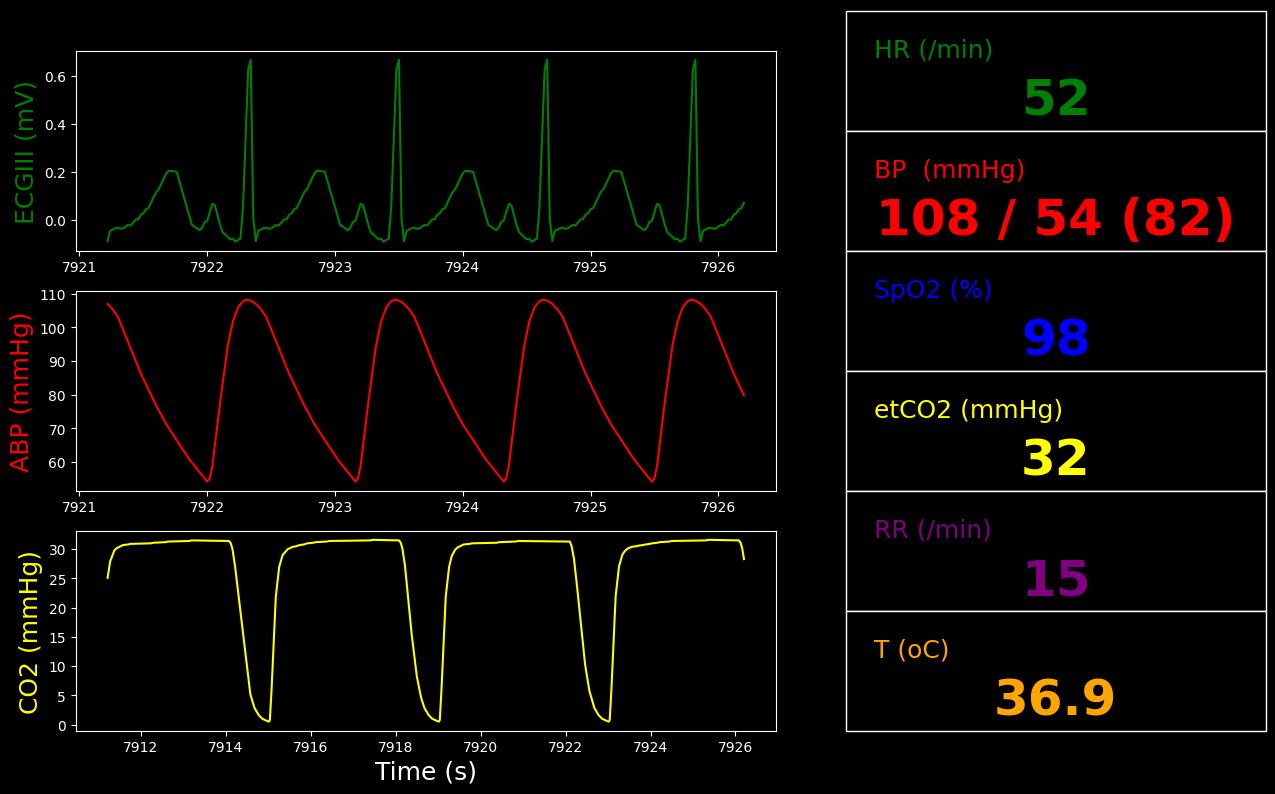
Initiate fluid resuscitation corresponding to 28 mL/kg total for a 59 kg female pig. 59kg*28 ml/kg = 1770ml -> / 60 min = 28 ml/min. Initiate fluid resuscitation with blood corresponding to 14 mL/kg total for a 59 kg female pig. 59kg*14 ml/kg = 826ml -> / 60 min = 14 ml/min. Simulate for 60 minutes.
| Property Name | Validation | Engine Value | Percent Error | Percent Change | Notes |
|---|---|---|---|---|---|
| HeartRate(1/min) | EqualTo Segment4 (125) [128] | 51.6 | -58.72% | ||
| MeanArterialPressure(mmHg) | EqualTo 3*Segment4 (174) [128] | 82.5 | -52.71% | ||
| Lactate-BloodConcentration(mg/dL) | EqualTo 1.21*Segment4 (98.5) [128] | 48.1 | -51.17% | ||
| BloodVolume(mL) | EqualTo 5008 [128] | 5.38e+03 | 7.41% | ||
| TotalHemorrhagedVolume(mL) | EqualTo 1770 [128] | 1.70e+03 | -3.67% |
 |
Segment 6
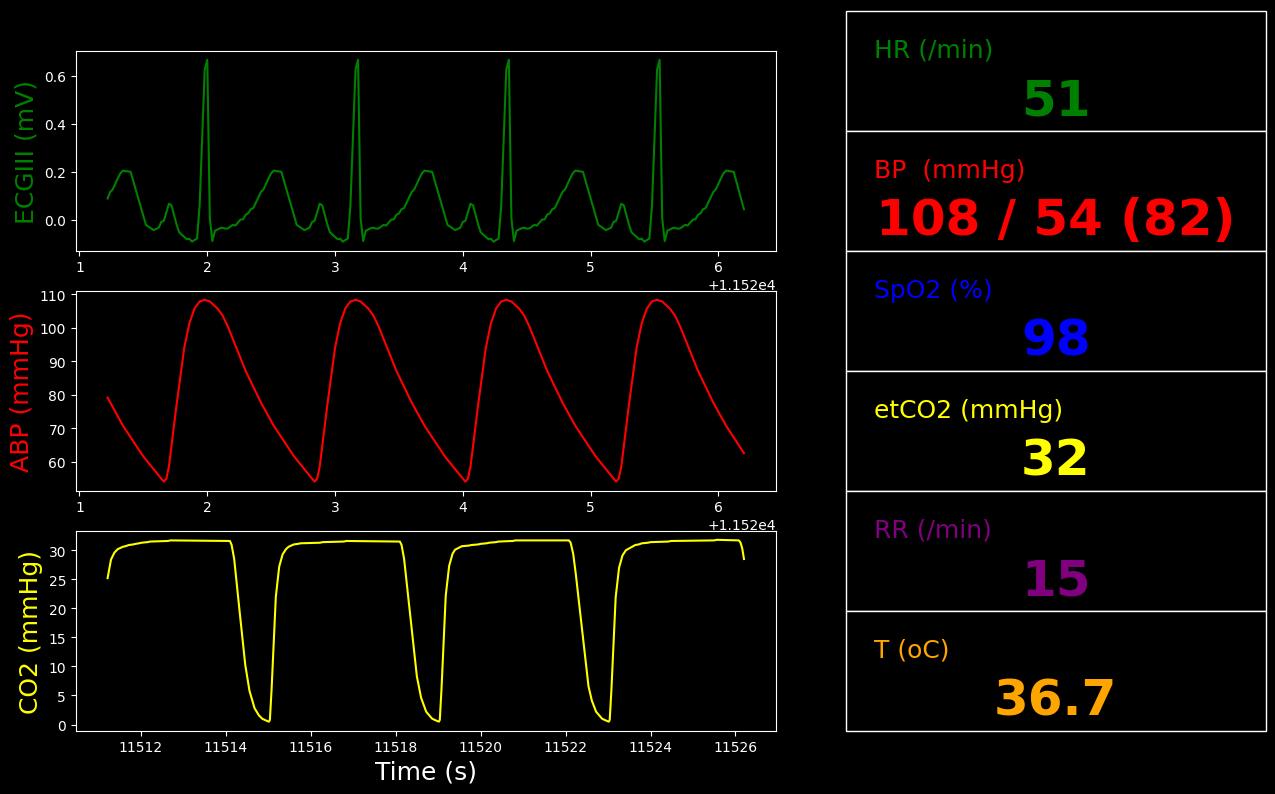
Stop fluid resuscitation Initiate fluid resuscitation with blood corresponding to 14 mL/kg total for a 59 kg female pig. 59kg*14 ml/kg = 826ml -> / 60 min = 14 ml/min. Simulate for 60 minutes.
| Property Name | Validation | Engine Value | Percent Error | Percent Change | Notes |
|---|---|---|---|---|---|
| HeartRate(1/min) | EqualTo Segment5 (51.6) [128] | 51.0 | -1.28% | ||
| MeanArterialPressure(mmHg) | EqualTo Segment5 (82.5) [128] | 82.5 | 0.02% | ||
| Lactate-BloodConcentration(mg/dL) | EqualTo 0.57*Segment5 (27.4) [128] | 52.1 | 89.99% | ||
| BloodVolume(mL) | EqualTo 5008 [128] | 5.36e+03 | 7.01% | ||
| TotalHemorrhagedVolume(mL) | EqualTo 1770 [128] | 1.70e+03 | -3.67% |
 |
Scenario Output Plots
 |
 |
 |
|
 |
 |